How to Tell When a Tree Is About to Fail in Brecksville
Living in Brecksville, Ohio, means living among one of the most impressive urban canopies in the Midwest. Our proximity to the Cuyahoga Valley National Park and the Brecksville Reservation provides a lush, forested backdrop that defines our community’s character. However, that beauty comes with a significant responsibility: monitoring the structural integrity of the massive hardwoods that shade our homes. In Northeast Ohio, we deal with a specific "Perfect Storm" of environmental stressors—heavy clay soil, lake-effect wind shear, and extreme temperature fluctuations—that can turn a healthy-looking tree into a significant hazard overnight. As a homeowner, you don't need to be a certified arborist to spot the early warning signs of tree failure. You simply need to know where to look. In our experience at All Seasons Tree Pros, most "emergency" removals could have been predicted months in advance if the owner knew how to read the tree’s body language. This guide provides the technical "Information Gain" you need to protect your property and your family. ________________________________________ H2: The Geology of Failure: Why Brecksville Soil Matters Before looking at the branches, we have to look at the ground. Brecksville’s soil is primarily composed of heavy silty clays. This matters for tree stability for two reasons: compaction and saturation. In a typical suburban environment, construction often compacts the soil around a tree's root zone. Because clay particles are so small, they compress easily, squeezing out the oxygen that roots need to survive. A tree with a "suffocated" root system cannot anchor itself properly. Furthermore, during the wet Ohio springs, this clay becomes oversaturated. When the ground is "plastic" (soft and muddy), it loses its "shear strength." If a 70-foot Oak is hit by a 50 mph gust of wind coming off Lake Erie while the ground is saturated, the entire root plate can lift out of the earth. This is known as windthrow, and it is the leading cause of tree failure in our area. ________________________________________ H2: Red Flag #1: The Root Plate and the "Ground Heave" The most dangerous sign of an impending tree fall is heaving soil. Go to the side of the tree opposite of the way it is leaning. Look at the ground where the trunk meets the grass (the root flare). If you see the soil mounded up, or if you see fresh cracks in the dirt where the grass has been pulled apart, the tree is physically pulling out of the ground. H3: Distinguishing a "Natural Lean" from "Active Failure" Many trees in the Brecksville Reservation grow at an angle to reach sunlight. This is a "phototropic" lean and is usually safe because the tree has grown "self-correcting" wood to compensate for the weight. ● Safe Lean: The trunk is curved. The tree grew sideways but then straightened out as it reached the light. ● Dangerous Lean: The trunk is straight, but the entire tree is tilted. This indicates the roots have shifted. If you notice a lean that appears suddenly after a storm, or if you can see white, fleshy roots exposed to the air, this is a Critical Hazard. The tree should be removed immediately before the next wind event. ________________________________________ H2: Red Flag #2: Co-Dominant Stems and Included Bark In the tree service industry, we call the "V-shaped" union between two trunks a Co-Dominant Stem. While these are common in Maples and Pears, they are one of the most frequent points of structural failure. H3: The Physics of the "V" vs. the "U" ● The "U" Shape: A strong union has a wide, rounded base. The wood of the two stems is physically knitted together, creating a strong "collar." ● The "V" Shape: The two stems grow so close together that bark becomes trapped between them. This is called Included Bark. Included bark acts like a wedge. As the two stems grow in diameter, they literally push each other apart. In Brecksville, when heavy ice or snow accumulates on the canopy, the weight pulls these two stems in opposite directions. Because there is no actual wood-to-wood connection in the "V," the trunk will split down the middle. If you see a vertical crack starting at the junction of two trunks, the tree is literally "unzipping." ________________________________________ H2: Red Flag #3: Hollows, Cavities, and Heartwood Rot Trees grow from the outside in. The center of the tree, the heartwood, is technically dead tissue that provides the "backbone" or structural support. The outer layers (the cambium and sapwood) are the "living" parts that transport water and nutrients. A tree can look perfectly green and healthy while being almost entirely hollow. H3: Using "Experience Markers" to Spot Decay Look for these signs of internal rot: 1. Cavitites: Large holes in the trunk where a branch once was. If you can stick a yardstick into the hole and not hit resistance, the tree’s structural "pipe" is compromised. 2. Conks and Mushrooms: If you see shelf-like fungi (Brackets) growing on the bark, it means a fungus is actively digesting the tree's internal cellulose. 3. Carpenter Ants: Contrary to popular belief, carpenter ants don't eat healthy wood. They move into wood that is already soft and rotting. If you see a trail of large black ants or piles of "frass" (sawdust) at the base of your tree, you have an internal decay problem. ________________________________________ H2: Red Flag #4: The Danger of Cankers and "Dead Bark" A canker is like an open sore on a tree. It is an area where the bark has died back due to disease or mechanical injury (like a lawnmower strike or a car bumper). While a small canker is usually fine, a large one can cause the tree to snap. Think of the tree trunk as a structural beam. If you notch 40% of a beam, it will fail under a load. If a canker covers more than one-third of the circumference of the trunk, the tree has a high "probability of failure" at that exact height. ________________________________________ H2: Red Flag #5: Deadwood and "Widow-Makers" The most common hazard in Brecksville isn't the whole tree falling; it’s a single large branch failing. H3: Identifying Dead Wood In the summer, deadwood is easy to spotit has no leaves. In the winter, it’s harder. Look for branches where the bark is peeling off or where the tips look "brittle" and grey compared to the supple, brown tips of healthy branches. "Widow-Makers" are dead branches that have already snapped but are caught in the canopy. These are incredibly dangerous because they can be dislodged by a light breeze or even the weight of a bird. If you have children playing in a backyard with large, overhanging deadwood, professional tree trimming is not just an aesthetic choice; it is a safety requirement. ________________________________________ H2: The Specific Threat of the Emerald Ash Borer in Ohio We cannot discuss tree failure in Brecksville without mentioning the Emerald Ash Borer (EAB). Over the last decade, this invasive beetle has decimated the Ash population in Northeast Ohio. If you have an Ash tree on your property that hasn't been treated with annual trunk injections, it is likely dead. Unlike Oaks, which stay structurally sound for years after they die, Ash wood becomes "glass-brittle" almost immediately. We have seen Ash trees that looked sturdy snap like toothpicks under the weight of a light snowfall. If you have a dead Ash near your driveway or house, tree removal should be your #1 priority. ________________________________________ H2: How to Perform a "Walk-Around" Inspection We recommend Brecksville homeowners perform a DIY inspection twice a year: once in the late fall after leaves have dropped, and once in the spring. 1. The 360-Degree View: Stand back and look at the whole tree. Is it leaning? Does the canopy look lopsided? 2. The Ground Check: Look for "ground heave," mushrooms, or sawdust at the base. 3. The Trunk Check: Look for cracks, "V" junctions, and peeling bark. 4. The Canopy Check: Look for dead branches or "hangers." ________________________________________ H2: When to Call a Professional If you spot any of the red flags mentioned above, do not attempt to "test" the tree yourself. Many homeowners make the mistake of trying to pull a leaning tree back with a truck and a chain. This is extremely dangerous and often results in the tree falling in the wrong direction. A certified tree service professional uses specialized tools like a Resistograph (which measures wood density) or a rubber mallet to "sound" the tree. We can determine if the tree can be saved through Cabling and Bracing, a process where we install high-strength steel cables to support co-dominant stems, or if emergency removal is the only safe option. ________________________________________ H2: Summary of Tree Failure Indicators Visual Sign Technical Name Danger Level Immediate Action Mounded soil at base Ground Heaving Critical Evacuate the area, call for removal Narrow "V" split Included Bark High Install cables or remove one stem Mushrooms on the trunk Fungal Conks High Structural density test required Deep vertical crack Structural Fracture High Immediate professional assessment Dead top branches Dieback Medium Pruning and soil fertilization ________________________________________ H2: Protecting Your Brecksville Home Your trees are an investment. They provide shade, beauty, and property value. By catching these signs of failure early, you can often save the tree through corrective pruning rather than losing it entirely to a storm. At All Seasons Tree Pros, we pride ourselves on being honest stewards of the Brecksville canopy. We won't tell you a tree needs to come down if it can be safely braced. Our goal is to keep our neighborhoods both beautiful and safe. Do you suspect one of your trees is showing these signs? Don't wait for the next storm. Contact us today for a free Hazard Assessment and let our local experts give you peace of mind.
Living in Brecksville, Ohio, means living among one of the most impressive urban canopies in the Midwest. Our proximity to the Cuyahoga Valley National Park and the Brecksville Reservation provides a lush, forested backdrop that defines our community’s character. However, that beauty comes with a significant responsibility: monitoring the structural integrity of the massive hardwoods that shade our homes.

In Northeast Ohio, we deal with a specific “Perfect Storm” of environmental stressors—heavy clay soil, lake-effect wind shear, and extreme temperature fluctuations—that can turn a healthy-looking tree into a significant hazard overnight. As a homeowner, you don’t need to be a certified arborist to spot the early warning signs of tree failure. You simply need to know where to look.

In our experience at All Seasons Tree Pros, most “emergency” removals could have been predicted months in advance if the owner knew how to read the tree’s body language. This guide provides the technical “Information Gain” you need to protect your property and your family.

The Geology of Failure: Why Brecksville Soil Matters

Before looking at the branches, we have to look at the ground. Brecksville’s soil is primarily composed of heavy silty clays. This matters for tree stability for two reasons: compaction and saturation.

In a typical suburban environment, construction often compacts the soil around a tree’s root zone. Because clay particles are so small, they compress easily, squeezing out the oxygen that roots need to survive. A tree with a “suffocated” root system cannot anchor itself properly.

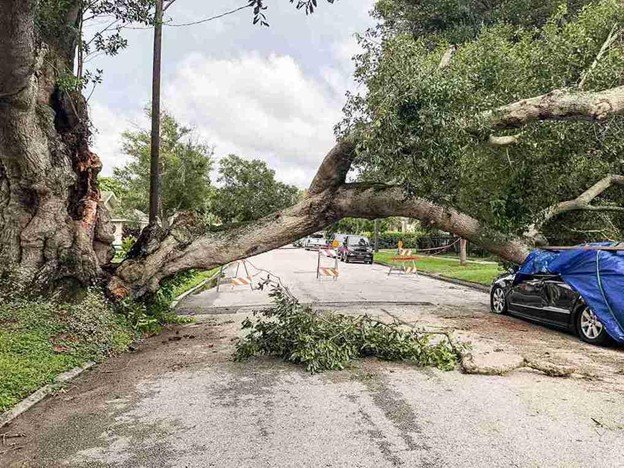
Furthermore, during the wet Ohio springs, this clay becomes oversaturated. When the ground is “plastic” (soft and muddy), it loses its “shear strength.” If a 70-foot Oak is hit by a 50 mph gust of wind coming off Lake Erie while the ground is saturated, the entire root plate can lift out of the earth. This is known as windthrow, and it is the leading cause of tree failure in our area.

Red Flag #1: The Root Plate and the “Ground Heave”

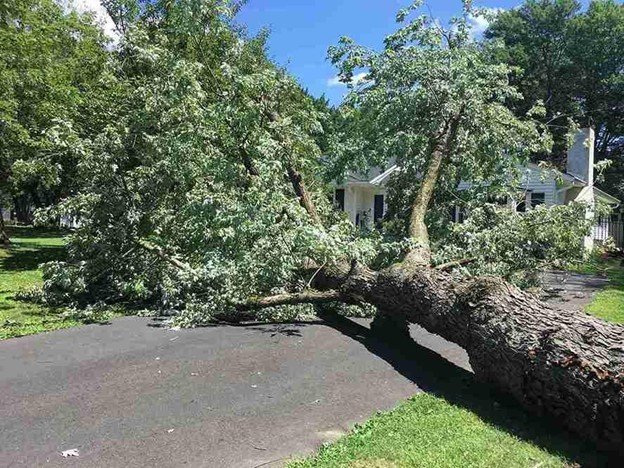
The most dangerous sign of an impending tree fall is heaving soil.

Go to the side of the tree opposite of the way it is leaning. Look at the ground where the trunk meets the grass (the root flare). If you see the soil mounded up, or if you see fresh cracks in the dirt where the grass has been pulled apart, the tree is physically pulling out of the ground.

Distinguishing a “Natural Lean” from “Active Failure”

Many trees in the Brecksville Reservation grow at an angle to reach sunlight. This is a “phototropic” lean and is usually safe because the tree has grown “self-correcting” wood to compensate for the weight.

  • Safe Lean: The trunk is curved. The tree grew sideways but then straightened out as it reached the light.
  • Dangerous Lean: The trunk is straight, but the entire tree is tilted. This indicates the roots have shifted.

If you notice a lean that appears suddenly after a storm, or if you can see white, fleshy roots exposed to the air, this is a Critical Hazard. The tree should be removed immediately before the next wind event.

Red Flag #2: Co-Dominant Stems and Included Bark

In the tree service industry, we call the “V-shaped” union between two trunks a Co-Dominant Stem. While these are common in Maples and Pears, they are one of the most frequent points of structural failure.

The Physics of the “V” vs. the “U”

  • The “U” Shape: A strong union has a wide, rounded base. The wood of the two stems is physically knitted together, creating a strong “collar.”
  • The “V” Shape: The two stems grow so close together that bark becomes trapped between them. This is called Included Bark.

Included bark acts like a wedge. As the two stems grow in diameter, they literally push each other apart. In Brecksville, when heavy ice or snow accumulates on the canopy, the weight pulls these two stems in opposite directions. Because there is no actual wood-to-wood connection in the “V,” the trunk will split down the middle. If you see a vertical crack starting at the junction of two trunks, the tree is literally “unzipping.”

Red Flag #3: Hollows, Cavities, and Heartwood Rot

Trees grow from the outside in. The center of the tree, the heartwood, is technically dead tissue that provides the “backbone” or structural support. The outer layers (the cambium and sapwood) are the “living” parts that transport water and nutrients.

A tree can look perfectly green and healthy while being almost entirely hollow.

Using “Experience Markers” to Spot Decay

Look for these signs of internal rot:

  1. Cavitites: Large holes in the trunk where a branch once was. If you can stick a yardstick into the hole and not hit resistance, the tree’s structural “pipe” is compromised.
  2. Conks and Mushrooms: If you see shelf-like fungi (Brackets) growing on the bark, it means a fungus is actively digesting the tree’s internal cellulose.
  3. Carpenter Ants: Contrary to popular belief, carpenter ants don’t eat healthy wood. They move into wood that is already soft and rotting. If you see a trail of large black ants or piles of “frass” (sawdust) at the base of your tree, you have an internal decay problem.

Red Flag #4: The Danger of Cankers and “Dead Bark”

A canker is like an open sore on a tree. It is an area where the bark has died back due to disease or mechanical injury (like a lawnmower strike or a car bumper).

While a small canker is usually fine, a large one can cause the tree to snap. Think of the tree trunk as a structural beam. If you notch 40% of a beam, it will fail under a load. If a canker covers more than one-third of the circumference of the trunk, the tree has a high “probability of failure” at that exact height.

Red Flag #5: Deadwood and “Widow-Makers”

The most common hazard in Brecksville isn’t the whole tree falling; it’s a single large branch failing.

Identifying Dead Wood

In the summer, deadwood is easy to spotit has no leaves. In the winter, it’s harder. Look for branches where the bark is peeling off or where the tips look “brittle” and grey compared to the supple, brown tips of healthy branches.

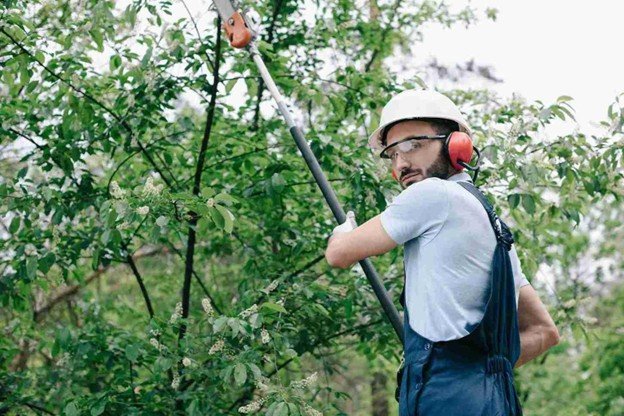
“Widow-Makers” are dead branches that have already snapped but are caught in the canopy. These are incredibly dangerous because they can be dislodged by a light breeze or even the weight of a bird. If you have children playing in a backyard with large, overhanging deadwood, professional tree trimming is not just an aesthetic choice; it is a safety requirement.

The Specific Threat of the Emerald Ash Borer in Ohio

We cannot discuss tree failure in Brecksville without mentioning the Emerald Ash Borer (EAB). Over the last decade, this invasive beetle has decimated the Ash population in Northeast Ohio.

If you have an Ash tree on your property that hasn’t been treated with annual trunk injections, it is likely dead. Unlike Oaks, which stay structurally sound for years after they die, Ash wood becomes “glass-brittle” almost immediately. We have seen Ash trees that looked sturdy snap like toothpicks under the weight of a light snowfall. If you have a dead Ash near your driveway or house, tree removal should be your #1 priority.

How to Perform a “Walk-Around” Inspection

We recommend Brecksville homeowners perform a DIY inspection twice a year: once in the late fall after leaves have dropped, and once in the spring.

  1. The 360-Degree View: Stand back and look at the whole tree. Is it leaning? Does the canopy look lopsided?
  2. The Ground Check: Look for “ground heave,” mushrooms, or sawdust at the base.
  3. The Trunk Check: Look for cracks, “V” junctions, and peeling bark.
  4. The Canopy Check: Look for dead branches or “hangers.”

When to Call a Professional

If you spot any of the red flags mentioned above, do not attempt to “test” the tree yourself. Many homeowners make the mistake of trying to pull a leaning tree back with a truck and a chain. This is extremely dangerous and often results in the tree falling in the wrong direction.

A certified tree service professional uses specialized tools like a Resistograph (which measures wood density) or a rubber mallet to “sound” the tree. We can determine if the tree can be saved through Cabling and Bracing, a process where we install high-strength steel cables to support co-dominant stems, or if emergency removal is the only safe option.

Summary of Tree Failure Indicators

Visual SignTechnical NameDanger LevelImmediate Action
Mounded soil at baseGround HeavingCriticalEvacuate the area, call for removal
Narrow “V” splitIncluded BarkHighInstall cables or remove one stem
Mushrooms on the trunkFungal ConksHighStructural density test required
Deep vertical crackStructural FractureHighImmediate professional assessment
Dead top branchesDiebackMediumPruning and soil fertilization

Protecting Your Brecksville Home

Your trees are an investment. They provide shade, beauty, and property value. By catching these signs of failure early, you can often save the tree through corrective pruning rather than losing it entirely to a storm.

At All Seasons Tree Pros, we pride ourselves on being honest stewards of the Brecksville canopy. We won’t tell you a tree needs to come down if it can be safely braced. Our goal is to keep our neighborhoods both beautiful and safe.

Do you suspect one of your trees is showing these signs? Don’t wait for the next storm. Contact us today for a free Hazard Assessment and let our local experts give you peace of mind.
Similar Posts